
I’ve known it for a few years – I’m a perfectionist. And unfortunately I know now, that is less of a good thing than I used to think it was. In fact it led to me being really quite ill and ultimately led to the significant career change I went through a few months ago. There was a really good article in The Guardian [1] that someone shared with me a few weeks ago which provided a very good summary of what being a perfectionist actually involves and some of the quotes from other people dealing with the condition were uncannily similar (and actually identical in a couple of cases) to things I have said to my wife and family over the past few years. I therefore thought I would share some of my experiences with the condition – I was officially diagnosed with “clinical perfectionism” in Autumn 2016 following a period of time off work due to anxiety and depression – and how I’ve learned to overcome the requirements my brain tries to instil in daily life and what coping mechanisms I now employ to stay both physically and mentally healthy!
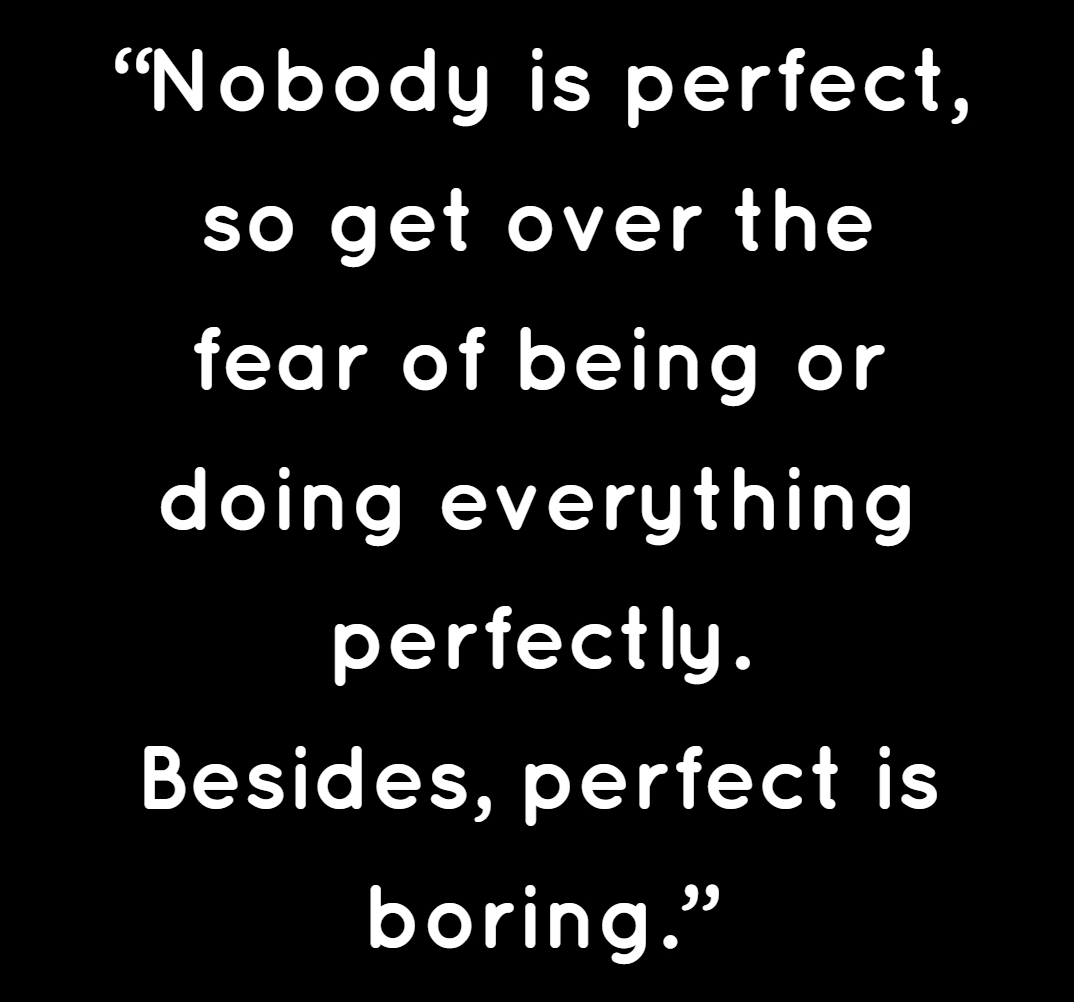
So what is perfectionism? It is described more as a personality trait rather than a mental health condition, but the result of having the trait often causes mental health issues, which in my case manifested as depression, anxiety and aspects of PTSD . The simplest way I have described it to people is an “overwhelming fear of failure“, with a very objective-driven mentality. No matter what you achieve, no matter the level of success, you always focus on what didn’t go right (I only scored 96/100, I made one mistake when performing all the music in that entire show, I could have run that 5 or 10K faster) and always looking forward, moving on to the next challenge, the next thing to accomplish, never being happy in the moment. Always planning. And it is exhausting! But the first step to change is recognising that change is required and so I set about gaining a better understanding of what I was dealing with. There are three types of perfectionism according to (Hewitt and Flett, 1991) [2]:
- socially prescribed – where a person believes that others require them to be perfect
- other-oriented – where a person requires others to be perfect
- self-oriented – where a person requires themselves to be perfect
In my case it was/is very much the third version, where the voice in my head was/is never satisfied and always required more effort, more work and more achievement. I don’t know when this first started, but while I was writing my PhD thesis back in 2015 my wife had to remind me to eat every meal as I would be so engrossed in what I was writing that I would ignore absolutely everything else, as in my mind nothing else was as important as getting the work done. And when I passed my viva voce [PhD speaking exam with 2 examiners – 1 internal from your own university, 1 external specialist in your area of research from another university – mine took place at the external examiner’s university due to her being heavily pregnant at the time!] with corrections to make, I was disappointed that my work was not good enough to have been passed straight away. And I remember starting planning what changes I needed to make in the car ride back home, already looking ahead to what I next needed to achieve, despite having spent an exhausting 3 hours 15 minutes discussing my work and “defending” all my research achievements and with multiple successful peer-reviewed publications of my work.

And this mentality came to a crashing impasse in Autumn 2016 when I first became operational in a new public-facing job involving a lot of long hours and feeling very out of my depth due to having so much to learn. When you have a brain screaming for everything to be done perfectly first time, making mistakes and not feeling at all confident in your decisions does not help! This was made worse by several difficult incidents I had to deal with in the job and I ended up taking time off work to get help after struggling to deal with mounting anxiety causing panic attacks and severe depression. That was when I got the diagnosis from a mental health specialist, started taking antidepressants to address the anxiety and depression symptoms, and received counselling in the form of Step 2 CBT [cognitive behavioural therapy] to start to tackle the underlying cause – the perfectionism.
I made good progress as a result of the treatment and after 9 months, I came off the medication and felt like I was coping well. This unfortunately did not last. Due to my desire to achieve and succeed – I am remarkably bad at saying “no” to people – I ended up taking on responsibility for a number of different projects at work, as well as trying to complete various assessments (including considerable fitness training) to get into a more specialist role within the department, AND trying to complete additional work outside of the job role as part of a talent management programme due to career ambitions. And of course all of this became too much and I ended up taking more time off work due to stress caused by an overwhelming feeling of failure, which manifested this time as significant and crippling anxiety and panic attacks, but no depression. So I was quite cheerful, but terrified! Once again I asked for help and restarted my medication and obtained further therapy to try to address the perfectionism mindset; the root cause of all the stress!
This time it seemed to make more of a difference, perhaps because I knew that I had to make significant changes in life in order to alter the way I am. I also made a very difficult decision to change careers after a very long period of reflection and (obviously, being the logical scientific person I am) a number of lists of positives and negatives! And it was definitely the right decision to make, as since then I have steadily improved and feel so much happier in my new role where I have been for a little while now.

So to make sure that I don’t fall back down the slope I have established a number of different “coping mechanisms” to maintain and improve my physical and mental fitness. I was advised by a mental health specialist from MIND, the amazing mental health charity, to – as he called it – “spread bet”. In that he meant that it’s all well and good having all of your coping mechanisms be in the form of exercise, but what happens if you get injured, or get a severe cold/flu that stops you from exercising for a few days/weeks? So the sensible person has a range of activities requiring a number of different skills and abilities that help to maintain mind health. Which is exactly what I’ve done. For me, I have always enjoyed exercise and have lately started playing football again, alongside running regularly and going to the gym. I found running immensely helpful when I was really struggling with anxiety, as it gave me something else to focus on and to just let my mind wander, as well as the feeling of tightness in my stomach I could attribute to the exercise rather than nerves so it gave me a great sense of peace! Alongside the running and weights, I also play various musical instruments – thanks to my parents who are both retired music teachers – and greatly enjoy playing trumpet with various groups. Like the running, it gives my brain something to focus on and it is always fun to play all the music around Christmas! And most recently I discovered an interest in woodworking – it gave me the opportunity to develop my more creative and artistic side, as well as use the logical scientific side to figure out how to construct things and to plan my approach to solving problems.

And so that has led to this blog, as a way to document and discuss interesting woodworking projects I’ve made, as well as share my exercise achievements (I’m running a 10K in London in February 2019 to raise money for Cancer Relief) and review my current mental health – I think I’m a 10 out of 10 currently, where 10 is completely “normal” as I call it and 1 is crying constantly and panic attacks. And I haven’t been at 1 for many months now! Here’s hoping I continue to develop my mental resilience, as well as get better at learning to relax and unwind too, although I don’t have to do it perfectly – good enough is good enough! 🔨
[1] Cocozz, 2018, ‘My brain feels like it’s been punched’: the intolerable rise of perfectionism, The Guardian Online, Available here
[2] Hewitt and Flett, 1991, “Perfectionism in the Self and Social Contexts: Conceptualization,Assessment, and Association With Psychopathology“, Journal of Personality and Social Psychology, 60, 3, P456-470 Available here
 The Woodworking Scientist