
One of the biggest difficulties for a woodworker on a rather limited budget, is to source usable wood cheaply. When we first moved to the area a couple of years ago, as I talked about here, I spent a while looking into various local timber merchants, which can be prohibitively expensive if you are not buying in larger quantities; as well as the usual DIY stores, where quality can be quite varied unfortunately. But after quite a bit of online searching, I found a charity down in Southampton called Southampton Wood Recycling (not sponsored!) that sells a wide variety of soft and hard woods at a decent price, as well as some wood furniture (also good to look at to get some ideas for my own projects!). They also have a fantastic selection of free “odd sized” wooden pallets stored outside (the UK or Euro pallets of a standard size are only a few pounds if you need consistency).
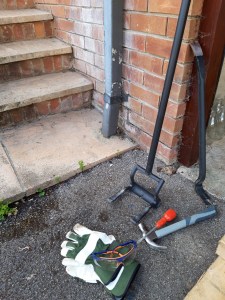
I made a few trips there back in 2019 and the start of 2020 before the first UK COVID lockdown, which meant I had a lot of potentially usable wood to salvage to keep me busy. I have seen lots of videos and demonstrations of how to dismantle pallets “efficiently” using both hand and power tools, including using a jigsaw to just cut the planks off, or using a reciprocating saw with a suitably tough blade to simply cut through the nails and separate the pieces from the base blocks. Neither of these methods are really suitable for me however (primarily due to not having a reciprocating saw!), but also because I want to recover as much usable wood as possible and cutting the nails then makes it harder to remove them from the wood, especially if they’re firmly embedded into the blocks between the slats.
Knowing I was probably going to be using quite a bit of pallet wood for some projects further down the line (to be shared on here over the next few months!) I decided to invest in a useful pallet levering tool (lots of different types are available) which would allow me to take the pallets apart while hopefully salvaging the most amount of wood possible by gently prying the planks apart. I’ve previously talked about the “Roughneck Pallet Buster” I got off Amazon (not sponsored) when I made my wood storage crate and I’ve used it a lot since I got it a couple of years ago. I’ve found it easiest to do this on a lowdown solid and flat surface, so moved the car off the drive and laid out the first pallet to be pulled apart. Working outside meant I also had space in the workshop to move the recovered wood into and I also wasn’t colliding with shelves or stored/hanging tools when trying to lever at different angles! And it also meant that I was a bit cooler in the fresh air too, as dismantling a lot of pallets is definitely an activity that gets your heart rate up!
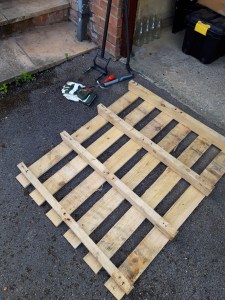
A flat surface provides stability for levering nails out 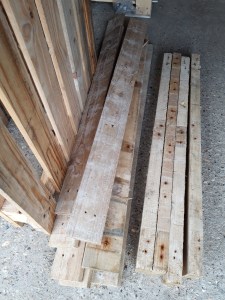
With some patience and care, you can salvage a lot of the wood
I started the process by using the pallet tool to try lifting the slats – some of them were very loose and came apart immediately. Others were quite a bit stiffer, particularly the pallets with actual solid wood blocks, rather than compacted sawdust. For these ones, I used a flat bladed screwdriver and a hammer to “gently” start to lift the planks, hitting the screwdriver under the plank until the nail raised up a bit. I then moved between the three sets of nails along the plank to reduce the amount of stress on the plank next to my point of lifting. Once I had gone the length of the plank with the screwdriver and hammer combo and there was a suitable space under the plank, I used a crowbar to lever the plank up progressively more, until I could get the pallet tool underneath and lever the plank off completely while standing up again. This was then simply repeated across all the pallet slats for one side, and then I turned the pallet over and did the whole process again; working from one side to the other using the selection of tools to raise the planks and rescue as much of the wood as possible.
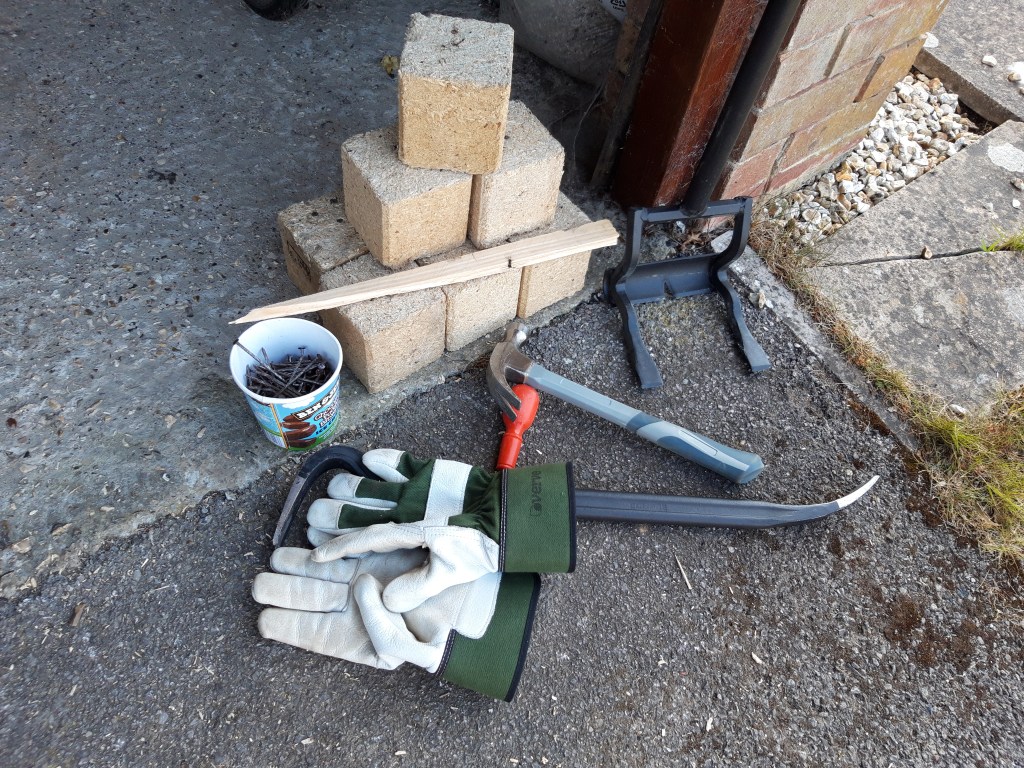
As I lifted the planks the nails were quite often worked loose and the heads then were raised slightly proud of the plank when it was replaced. When this happened I used the notch in the crowbar or a couple of times, the notch in the pallet tool, to prise the nail out. Some came out easier than others! And for some of the pallets, which were clearly very well used, the nails basically disintegrated when pulled, which resulted in me either ripping the remaining shank out with a pair of pliers, or just marking that section of the plank to highlight the remaining nail for when I come to use that piece at some point in the future. Pleasingly the majority of the nails actually came out without too much drama, but I made sure to wear safety specs just in case of flying metal, as wells as some thicker gloves to avoid getting splinters from the rougher sections of wood. I never wear gloves when using power tools to prevent them getting caught in anything, but for something like this, there are only so many times you can pull splinters out of your hands before a pair of heavy duty gloves seems like a good idea! One thing I have since added to my shopping list (and actually arrived last week!) is a pair of kneepads. These will make crawling around on the floor levering up the pallet slats a lot less hard going and will protect my knees from any rogue nails that missed going into the “highly sophisticated” collection pot (an empty ice cream tub!).
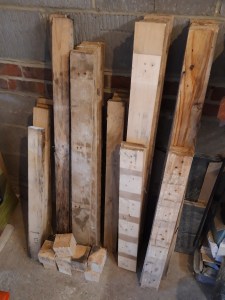
After an afternoon of effort in the fresh air, and a nice amount of aggression worked through with a hammer, I had managed to dismantle several pallets, leaving me with a nice selection of different sized planks, with varying widths and thicknesses. And aside from some hard work and the easy car journey to go and collect them all, I now have a nice selection of planks with quite a bit of usable undamaged space to turn into my next few projects. And as some of the pallets actually had wooden blocks rather than the compressed sawdust ones, I managed to salvage those blocks too, to turn into some small workpieces in the future. I haven’t found a use for the sawdust blocks though, so I will have to keep an eye out for pallets with proper wooden blocks in my next pallet haul adventures later this year! 🔨
 The Woodworking Scientist
3 thoughts on “Sources of wood – dismantling pallets”